
Indoor fiber optic network design in Europe requires strict adherence to life safety regulations, prioritizing the protection of human life against toxic gas and smoke. To legally install permanent cabling infrastructure within the European Union, obtaining CPR cable certification is an absolute mandatory requirement. Understanding the relationship between chemical material properties, such as LSZH (Low Smoke Zero Halogen), and legal Euroclass fire ratings is essential for global procurement and engineering compliance.
1. The Material Foundation: LSZH Fiber Cable
Traditional cabling often utilizes PVC (Polyvinyl Chloride), a material that releases heavy black smoke and highly toxic halogen gases when burned. These acidic byproducts pose severe risks to human life and cause irreversible corrosive damage to sensitive data center electronics.
The European market predominantly mandates LSZH fiber cable for indoor environments to mitigate these risks.
-
Zero Halogens: The jacket composition is entirely free of halogens (such as chlorine and fluorine). Upon combustion, it releases zero toxic or acidic gases.
-
Low Smoke: LSZH materials produce only a thin, translucent white smoke during a fire. This ensures visibility remains high for rapid emergency evacuations.
Note: LSZH denotes the physical material properties. Legal compliance for building installation in Europe requires further validation through CPR testing.
2. The Legal Standard: Euroclass Fire Ratings
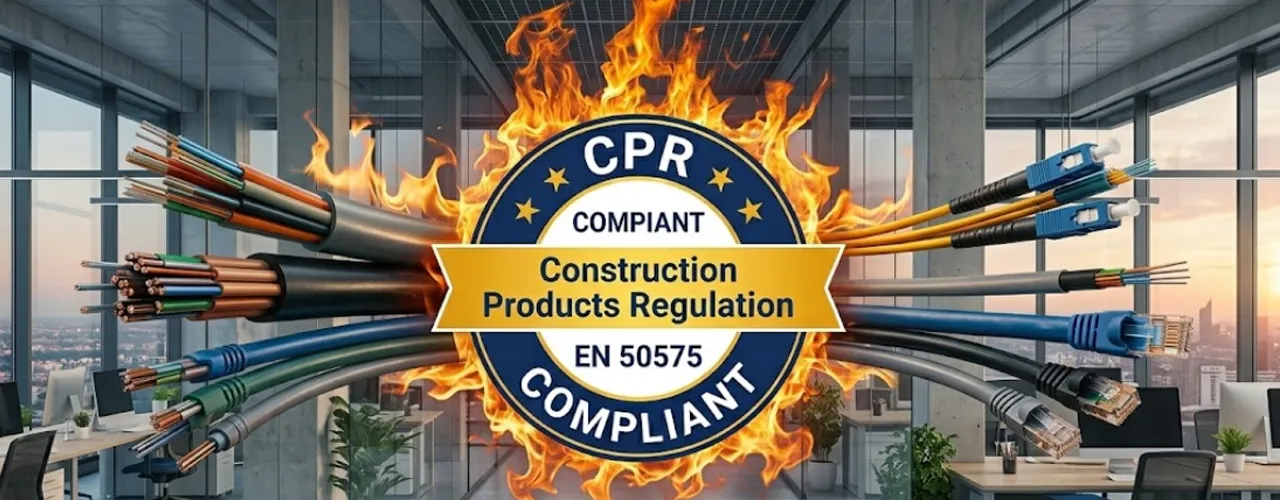
The Construction Products Regulation (Regulation No. 305/2011, or CPR) is a unified legal framework established by the European Union to govern the marketing and fire safety of building materials. While the overarching regulation was adopted in 2011, the specific harmonised standard for power, control, and communication cables (EN 50575) concluded its transition period later. Since July 1, 2017, it has been a mandatory legal requirement that any cable permanently installed in an EU building must carry a CE mark, a Declaration of Performance (DoP), and valid CPR cable certification.
Under this regulation, cables are classified into Euroclasses based on their reaction to fire. For telecommunications and IT infrastructure, the following classifications apply:
| Euroclass | Fire Reaction Level | Typical Installation Environments |
| B2ca | Very high flame retardancy | Hospitals, hyperscale data centers, critical escape routes. |
| Cca | High flame retardancy | High-occupancy commercial buildings, server rooms. |
| Dca | Moderate flame retardancy | Standard office spaces, general enterprise buildings. |
| Eca | Basic flame spread resistance | Small facilities with minimal safety risks. |
Additional Performance Criteria
High-tier cables (such as B2ca and Cca) are further evaluated on three crucial parameters:
-
Smoke (s1, s2, s3):
s1indicates the lowest smoke emission. -
Droplets (d0, d1, d2):
d0guarantees zero flaming droplets. -
Acidity (a1, a2, a3):
a1represents the lowest gas acidity, perfectly aligning with LSZH characteristics.
A premium data center cable typically carries the strict B2ca-s1,d0,a1 rating.
3. European Cabling Standards and Installation Guidelines
Deploying compliant infrastructure demands careful attention to regional variations and environmental factors.
-
National Building Codes: While CPR is an EU-wide framework, individual member states determine the specific Euroclass required for different building types. Certain regions mandate Cca or B2ca for public buildings, whereas others accept Dca for similar structures.
-
High-Density Environments: Modern data centers feature tightly packed cable trays, representing a concentrated fuel load. Utilizing B2ca-rated cables in these scenarios prevents catastrophic fire propagation, even when utilizing LSZH materials.
-
Legal Implications: Installing non-certified cabling risks severe legal penalties, failed building inspections, and invalidated insurance policies.
4. OEM Manufacturing and Compliance Guarantee
Achieving genuine CPR cable certification requires rigorous third-party auditing by Notified Bodies, continuous factory inspections, and advanced material engineering.
Geteknet operates as a premier OEM manufacturer, delivering fully compliant fiber optic solutions for the European market. From cost-effective Dca options for general enterprise use to ultra-secure B2ca-s1,d0,a1 cables for mission-critical infrastructure, every product is engineered with premium LSZH materials. All European shipments are backed by complete DoP documentation and verifiable CE marking.
Partnering with a certified OEM facility guarantees manufacturing consistency, mitigating compliance risks for complex global telecommunications projects.
Frequently Asked Questions
Q: Does an LSZH fiber cable automatically meet CPR cable certification?
A: No. LSZH defines the chemical composition of the jacket (zero toxic gas, low smoke). CPR is a mandatory legal framework that tests the actual fire performance (flame spread, heat release) to assign a specific Euroclass. An LSZH cable must pass CPR testing to be legally installed in Europe.
Q: What does the B2ca-s1,d0,a1 Euroclass fire rating signify?
A: This represents one of the highest safety classifications for indoor cables. B2ca indicates excellent flame retardancy. The ‘s1’ denotes minimal smoke production, ‘d0’ means zero flaming droplets, and ‘a1’ confirms negligible acidic gas release. It is the optimal standard for high-risk environments.
Q: Are OFNP (Plenum) cables permitted under European cabling standards?
A: Generally, no. OFNP is a North American standard prioritizing flame retardancy over material chemistry. OFNP cables frequently contain halogens (such as fluoropolymers) that emit toxic smoke during combustion, directly violating the zero-halogen and low-acidity requirements of high-tier European CPR classifications.