
In the era of AI-driven computing and hyperscale cloud environments, the demand for bandwidth is skyrocketing. As data centers migrate from 10G/40G to 400G and even 800G architectures, traditional LC duplex cabling is no longer sustainable due to space constraints and management complexity.
The solution lies in multi-fiber connectivity. MTP MPO fiber cables have emerged as the indispensable backbone of high-density (HD) data centers, offering a modular, scalable, and ultra-efficient way to manage thousands of fiber connections in a fraction of the space.

1. What are MTP MPO Fiber Cables?
To understand these cables, we must first distinguish between the connector standard and the brand.
-
MPO (Multi-fiber Push-On): This is the generic industry standard for multi-fiber connectors, defined by IEC 61754-7. It can house anywhere from 8 to 72 fibers in a single rectangular ferrule.
-
MTP®: Registered by US Conec, the MTP connector is a high-performance version of the MPO connector. It features mechanical and optical enhancements (such as floating ferrules and elliptical pins) that ensure superior signal integrity and lower insertion loss compared to generic MPO connectors.
For OEM manufacturers like Geteknet, providing high-spec MTP MPO fiber cables ensures that our clients’ physical layer can meet the stringent requirements of Tier 3 and Tier 4 data center standards.
2. Key Advantages in High-Density Environments
Why are MTP/MPO systems replacing traditional cabling in modern server rooms?
Space Efficiency and Port Density
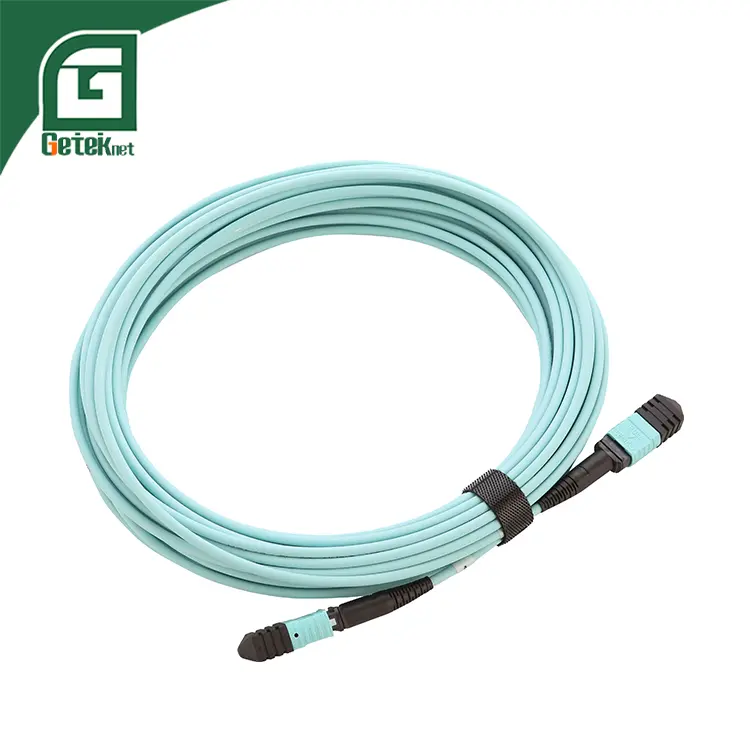
In a standard 1U rack space, using LC duplex connectors limits your density. By using MTP MPO fiber cables, a single connector can replace 12, 24, or even 16 (for 400G/800G) individual fibers. This drastically reduces cable bulk in pathways and improves airflow—a critical factor for cooling high-performance GPU clusters.
Rapid Deployment (Plug-and-Play)
Time is money in data center construction. MTP/MPO trunk cables are factory-terminated and pre-tested. Instead of spending hours splicing individual fibers, technicians can simply “plug and play” trunk lines into MTP cassettes. This can reduce installation time by up to 75%.
Future-Proofing for 400G and 800G
Current high-speed transceivers (like QSFP-DD or OSFP) utilize parallel optics. For example, a 400G SR8 connection requires 16 fibers. MTP/MPO technology is the only native interface that supports these parallel transmission protocols, allowing for a seamless path from 100G to 800G.
3. Understanding Polarity: The Silent Connectivity Killer
One of the biggest challenges when installing MTP MPO fiber cables is ensuring correct polarity—ensuring the “Light” goes from the “Transmitter” at one end to the “Receiver” at the other.
The TIA-568 standard defines three methods to manage polarity:
Type A (Straight-through): Uses a “Key Up to Key Down” adapter.
Type B (Crossover): Uses a “Key Up to Key Up” adapter, essential for 40G/100G parallel optics.
Type C (Flipped Pair): Each pair of fibers is flipped, used primarily in duplex-style networks.
Correct polarity management is vital for network uptime. As an OEM partner, Geteknet provides clearly labeled Type A, B, and C trunking solutions to simplify complex deployments for our clients.
4. Hardware Integration: ODFs and Patch Panels
The cable is only half the story. To truly leverage the power of MTP MPO fiber cables, they must be integrated into a robust hardware ecosystem:
-
High-Density Patch Panels: 1U panels that support up to 144 fibers using MTP-to-LC cassettes.
-
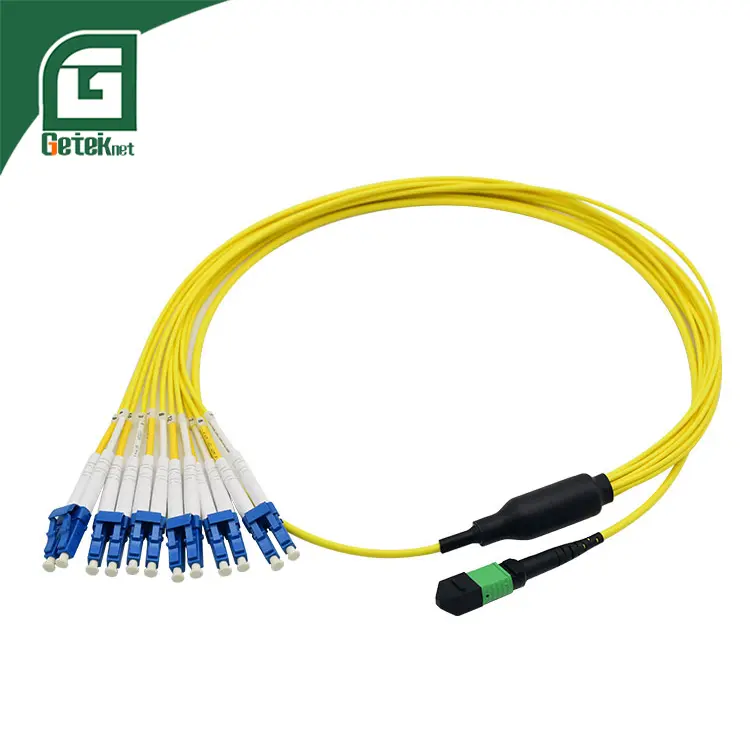
MTP Trunks & Harnesses: Transitioning from high-density backbone trunks to individual equipment connections (SFP/QSFP ports).
-
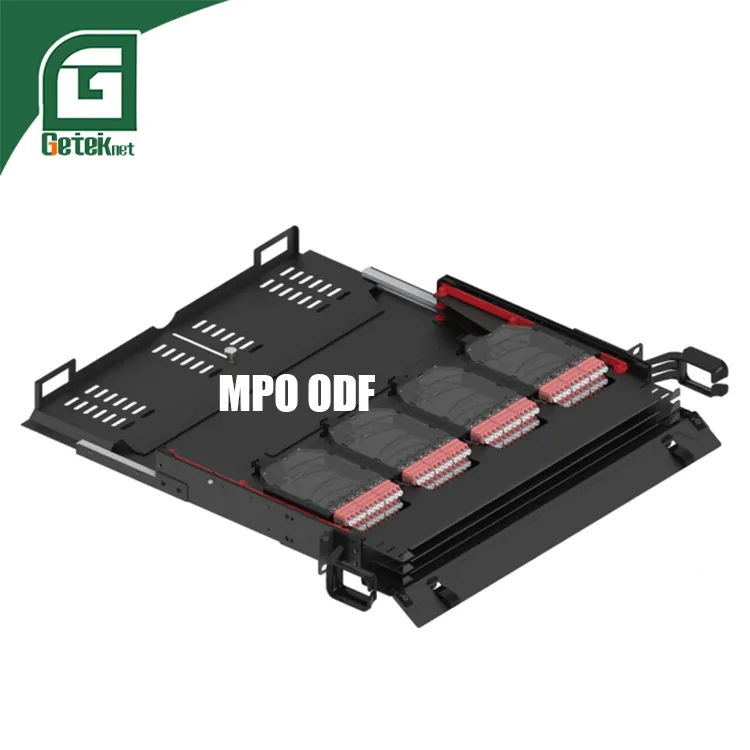
Optical Distribution Frames (ODF): Centralized management hubs that allow for massive cross-connect capabilities with minimal congestion.
Conclusion: Build Your HD Foundation with Geteknet
As data centers evolve into the “AI Era,” the physical layer must be more resilient and dense than ever. MTP MPO fiber cables provide the scalability, speed, and reliability required to prevent infrastructure bottlenecks.
Explore our
Frequently Asked Questions
Q: Is MTP compatible with MPO?
A: Yes. The MTP connector is fully compliant with MPO standards and is intermateable with any generic MPO connector. However, using an MTP connector provides better mechanical stability and lower insertion loss (IL).
Q: Why is 12-fiber MPO common, but 8-fiber MPO preferred for 400G?
A: While 12-fiber was the early standard, many modern transceivers use 8 fibers (4 Tx, 4 Rx) for 100G/400G. Using an 8-fiber MTP cable in these scenarios results in 100% fiber utilization, whereas a 12-fiber cable would leave 4 fibers unused (“Dark Fiber”).
Q: How do MTP MPO fiber cables improve airflow in a rack?
A: Because one MTP cable replaces 12 or 24 LC cables, the total volume of cable in the back of the rack is significantly reduced. This eliminates “cable dams” that block cold air from reaching the server intakes and prevents hot air from exhausting efficiently.