
Data center containment strategies isolate airflow to optimize thermal management. Cold aisle containment (CAC) traps supply air to cool equipment intake, while hot aisle containment (HAC) captures exhaust air for direct return to CRAC units. HAC generally offers better PUE efficiency for high-density racks, though CAC is easier to retrofit.
As compute densities increase with blade servers, AI clusters, and Hyper-Converged Infrastructure (HAC), legacy open-aisle cooling fails. Without physical barriers, cold supply air mixes with hot exhaust air. This bypass airflow forces Computer Room Air Conditioning (CRAC) units to run continuously, driving up the facility’s Power Usage Effectiveness (PUE). Implementing rigorous data center containment strategies is a mandatory engineering requirement to protect hardware and reduce operational expenditures (OpEx).
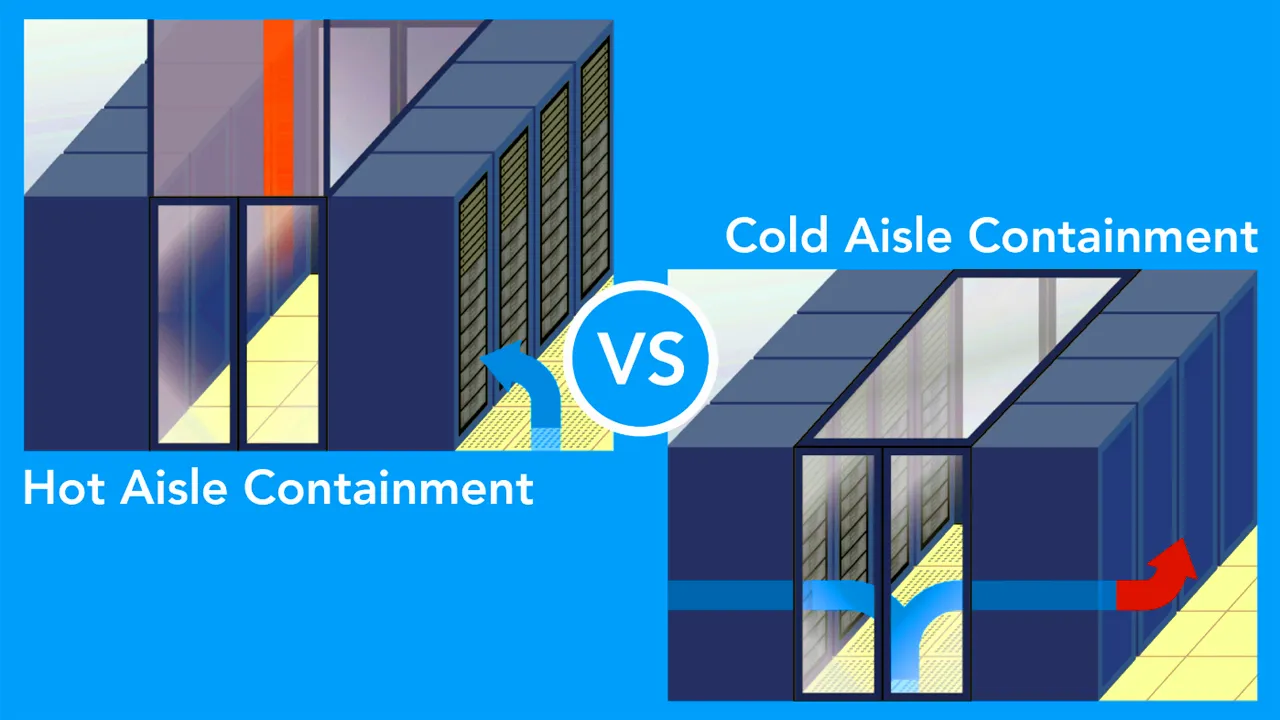
The Physics of Airflow Containment
Effective containment relies on strict separation. By sealing either the cold supply or the hot exhaust, engineers increase the return air temperature to the CRAC units. Higher return temperatures improve the heat exchange efficiency of the cooling coils. Consequently, CRAC units draw less power, yielding a lower, optimized PUE. Geteknet engineers specialized containment panels, doors, and heavy-duty racks to ensure zero leakage in these critical environments.
Cold Aisle Containment (CAC) Architecture
Cold Aisle Containment (CAC) encloses the cold aisle, trapping chilled air delivered through a raised floor directly in front of the server intakes.
-
Engineering Advantage: CAC allows the rest of the data hall to become a large hot-air return plenum. This setup is highly effective for retrofitting existing facilities because it primarily requires adding roof panels and sliding doors to the ends of the cold aisles.
-
Installation Focus: Frontline installers utilize modular, tool-less polycarbonate roof panels and dual-sliding doors. These elements must integrate seamlessly with standard 42U or 47U rack profiles to maintain the air seal.
-
Limitations: Because the ambient data hall temperature rises (often exceeding 85°F/29°C), technicians working outside the contained cold aisle face elevated thermal discomfort.
Hot Aisle Containment (HAC) Architecture
Hot Aisle Containment (HAC) encloses the hot exhaust aisle, capturing the heat rejected by the servers and ducting it directly up to a drop ceiling return plenum.
-
Engineering Advantage: HAC is the definitive standard for high-density, greenfield data centers. By ducting hot air directly to the CRAC return, the system achieves a higher Delta T (temperature differential) across the cooling coils. This drastically improves chiller efficiency.
-
Operational Benefit: The ambient room temperature remains cool (around 72°F/22°C), providing a comfortable environment for IT staff.
-
Procurement Considerations: HAC typically requires a higher initial Capital Expenditure (CapEx) because it mandates a suspended ceiling and precise ductwork engineering.
Technical Comparison: CAC vs. HAC
To assist procurement teams and network architects in evaluating these data center containment strategies, we have compiled the operational metrics below:
| Metric / Feature | Cold Aisle Containment (CAC) | Hot Aisle Containment (HAC) |
| Primary Mechanism | Encloses supply air; room becomes hot | Encloses exhaust air; room stays cool |
| Cooling Efficiency (PUE Impact) | High (Excellent for retrofits) | Maximum (Best for high-density computing) |
| Initial CapEx / Installation Cost | Lower (Requires doors and roof panels) | Higher (Requires drop ceilings/ducting) |
| Technician Working Environment | Hot outside the aisle | Cool outside the aisle |
| Ride-Through Time (Power Outage) | Lower (Cold air depletes quickly) | Higher (Data hall holds cold air volume) |
OEM Manufacturing with Geteknet
Executing a future-proof thermal management strategy requires reliable physical infrastructure. Off-the-shelf panels often suffer from poor tolerances, leading to air leakage and reduced efficiency.
Geteknet represents manufacturing excellence, providing highly scalable OEM solutions for data center containment. Our R&D flexibility allows buyers to specify custom-dimensioned containment doors, fire-safe drop-away roof panels, and heavy-duty racks that integrate perfectly with existing structural grids. By partnering with Geteknet, B2B distributors and enterprise buyers secure cost-efficient, high-yield containment infrastructure that strictly complies with global thermal and fire safety standards.
Frequently Asked Questions
Q: Does cold aisle containment significantly reduce Power Usage Effectiveness (PUE)?
A: Yes, significantly. By preventing the mixing of hot and cold air, cold aisle containment allows CRAC units to operate more efficiently, often reducing cooling energy consumption by 20% to 40% and lowering overall PUE.
Q: Can I mix hot and cold aisle containment in the same data hall?
A: No, this is strongly discouraged. Mixing strategies disrupts the precise pressure differentials and return air plenums required for efficiency. A facility must commit to either entirely hot or entirely cold containment for optimal thermal management.
Q: Do containment systems require fire suppression integration?
A: Yes, strictly. Containment roofs and doors alter the physical space, potentially blocking overhead sprinklers or gas systems. You must utilize CE-listed drop-away roof panels that automatically release during a thermal event to comply with NFPA fire codes.