
Cable management plays a critical role in maintaining a stable, efficient, and future-proof network. Whether in an enterprise wiring closet or a high-density data center, cable organization affects airflow, maintenance efficiency, and long-term system reliability. This article provides a clear technical view of cable management racks, their structures, and how to select the right solution for modern networks.
1. What Cable Management Does for a Network Cabinet
A cable management rack is designed to route, protect, and organize copper and fiber cables inside network cabinets. Beyond keeping cables tidy, a well-structured cable manager reduces cable stress, improves heat dissipation, and ensures bend-radius compliance for data transmission stability. Proper management also shortens maintenance time, especially in cabinets with frequent patching and re-patching.
For installers and integrators, clean routing is no longer an aesthetic preference but a technical requirement for structured cabling systems.
2. Main Types of Cable Management Racks
Modern network infrastructures use several forms of cable managers, each with specific advantages. The most common types include:
Horizontal Cable Manager (1U / 2U)
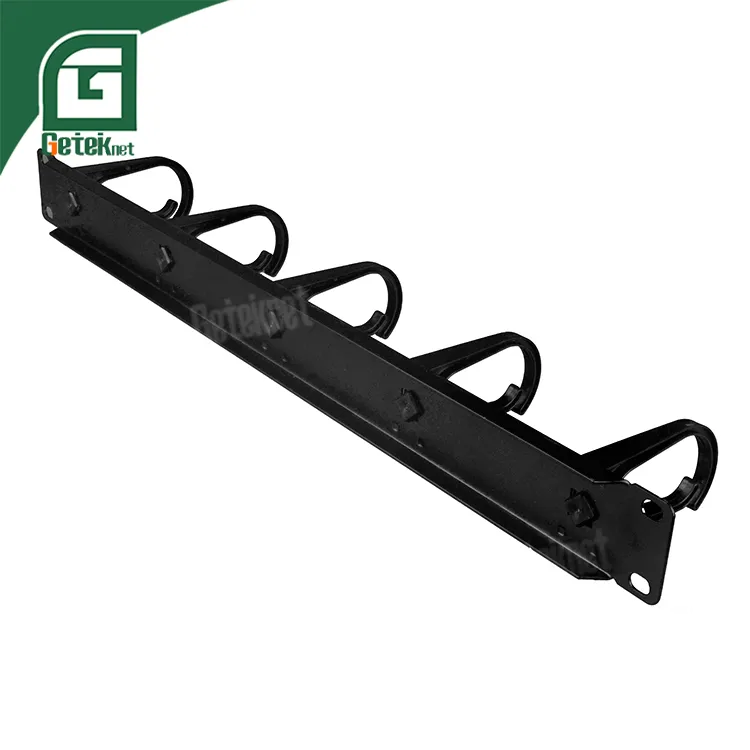
A horizontal cable manager guides patch cords across the rack’s front. It often includes plastic or metal rings, D-rings, or a brush panel to support structured routing. These managers prevent cable sagging and maintain uniform patch cord paths between switches or patch panels.
Vertical Cable Manager
Vertical cable managers run along both sides of a 19-inch cabinet. They provide dedicated cable channels that support high-density environments. The wide capacity helps separate copper and fiber links while ensuring consistent bend-radius control.
Brush Panel & Pass-Through Panels
Brush panels are used for cable entry and exit points, reducing dust intrusion and maintaining a clean front layout. They also help with strain relief when connecting cables across different U-levels.
Finger-Duct Type Cable Managers
Finger-duct designs enable precise routing for each cable group. The slotted ducts allow technicians to guide bundles into specific openings, improving organization in dense switch cabinets.

3. Key Technical Features to Consider
When choosing cable management for network racks, several technical factors influence long-term durability and installation performance:
-
Material Strength – Metal cable managers increase rigidity, while ABS plastic is lightweight and cost-efficient.
-
Bend-Radius Protection – Essential for maintaining signal integrity in both fiber and copper cabling.
-
Strain Relief Points – Prevents cable damage during equipment movement or re-patching.
-
Airflow Optimization – Proper routing improves ventilation around switches and servers.
-
Compatibility with 19-inch Racks – Ensures seamless installation with standard equipment.
-
Front and Rear Cable Guidance – Useful for dual-sided patching environments.
These engineering aspects directly affect system performance and serviceability.
4. Best Practices for Cable Management in Structured Cabling
To maintain a clean and manageable cabinet, professionals generally follow these practices:
-
Separate power and data cables to avoid interference.
-
Use color-coded patch cords for faster identification.
-
Keep cable lengths appropriate to reduce slack.
-
Route cables along vertical managers before horizontal ones.
-
Avoid overfilling channels; leave room for future expansion.
-
Label both ends of every cable for quick troubleshooting.
Consistent organization not only improves clarity but also reduces downtime during network upgrades.

5. Cable Management Solutions from Geteknet
As an OEM manufacturer specializing in cable management accessories, Geteknet provides a full range of 19-inch cable managers, brush panels, and wiring accessories for data center and enterprise network projects. The company focuses on stable materials, precise mold design, and high-density solutions tailored for system integrators and distributors.
Geteknet also offers customization options, including branding, material selection, ring types, and structural variations to match different cabinet designs. For bulk or project-based purchases, OEM production helps maintain consistent quality and reduce installation complexity across a full wiring system.
Schlussfolgerung
A well-designed cable management rack ensures tidy routing, consistent bend-radius protection, and better airflow inside network cabinets. With the increasing density of switches and patch cords, structured cable management has become essential rather than optional. By understanding product types and technical features, installers can build a more reliable and scalable network infrastructure.
For companies seeking OEM-level cable management solutions, Geteknet provides professional manufacturing support tailored to modern cabling projects.
Contact Geteknet now to discuss your specifications and get a custom quote.

 German
  English
  Italian
  Spanish