
Introduction: The Critical Component in the Ethernet Physical Layer
RJ45 Connector (Registered Jack 45), specifically designated as the 8P8C Modular Connector under the ISO/IEC 8877 standard, serves as the fundamental interface for modern Ethernet Physical Layer interconnects utilizing twisted-pair media. Through adherence to strict Cabling Standards, the RJ45 ensures high-speed and reliable Data Transfer across Local Area Networks (LANs). This article provides a technical dissection of the RJ45’s structure, the imperative T568A and T568B specifications, and its critical role in contemporary Network Engineering.
1. Technical Specifications and Physical Architecture: The 8P8C Interface
The RJ45 Connector is fundamentally an 8-Position, 8-Contact (8P8C) modular plug engineered to minimize Crosstalk and Electromagnetic Interference (EMI) during high-frequency signal propagation:
-
Twisted Pair Mechanism: The efficacy of the RJ45 hinges on the inherent properties of Unshielded Twisted Pair (UTP) cabling. The deliberate intertwining of wire pairs counteracts externally induced Crosstalk, and the sequenced arrangement within the connector (governed by the TIA/EIA-568 standards) further optimizes this mechanism.
-
Impedance Matching: The assembly of the RJ45 Connector and the Ethernet Cable forms a transmission line. Its characteristic impedance (typically 100 Omega) must be precisely matched with the transceiver impedance to mitigate Signal Reflection and maintain Signal Integrity.
2. Standardization Imperative: T568A and T568B Pinout Standards
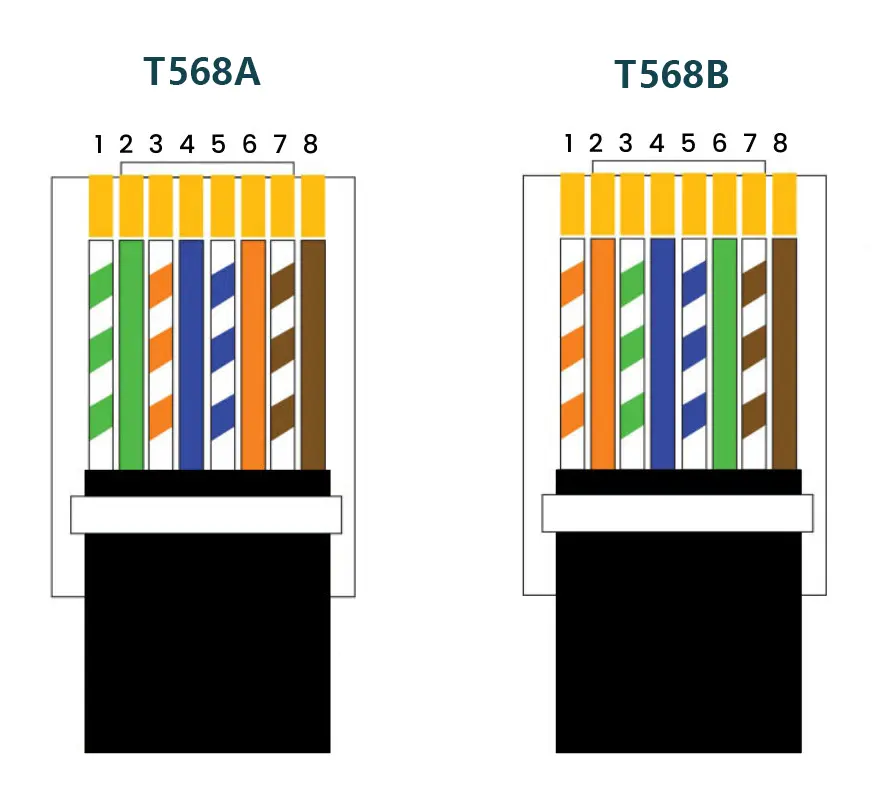
In Network Cabling, the T568A and T568B standards represent the only globally accepted industry-level Standardization schemes. These standards define the critical Pinout Diagram for the eight conductors.
| Pin | T568A Wire Order | T568B Wire Order | Signal Designation (10/100BASE-T) |
| 1 | White/Green (W-G) | White/Orange (W-O) | Tx+ (Transmit Data Positive) |
| 2 | Green (G) | Orange (O) | Tx- (Transmit Data Negative) |
| 3 | White/Orange (W-O) | White/Green (W-G) | Rx+ (Receive Data Positive) |
| 6 | Orange (O) | Green (G) | Rx- (Receive Data Negative) |
Note: Pins 4, 5, 7, and 8 are non-data carrying in 10/100BASE-T, but all eight conductors are fully utilized for bi-directional transmission in Gigabit Ethernet.
3. Critical Selection: Shielded vs. Unshielded RJ45 (STP vs. UTP)
The choice between Shielded Twisted Pair (STP) and Unshielded Twisted Pair (UTP) RJ45 Connectors is a critical design decision based on the operating environment and required performance:
| Merkmal | UTP RJ45 Connector | STP RJ45 Connector |
| EMI/RFI Resistance | Low (relies only on twisting) | High (requires metal foil or mesh shielding) |
| Grounding | Not required | Mandatory; requires continuity to ground |
| Best Use Case | Typical office/residential environment, low noise | Industrial settings, high-power adjacent cabling, long runs |
Deploying STP connectors without proper grounding is counterproductive, as the shield acts as an antenna, potentially increasing noise coupling. Professional installations only utilize STP when paired with Shielded Ethernet Cable and grounded patch panels.
4. Evolution of Assembly: RJ45 Connector Types and Installation
The market offers several types of Modular Plugs to optimize the field termination process. Understanding How to Crimp RJ45 depends heavily on the chosen connector type:
-
Standard Connector: This traditional design requires precise trimming of the conductors before insertion into the plug body. The technician must visually confirm the wires bottom out against the front face, a process prone to error if conductors are trimmed too short.
-
Pass-Through Connector: A modern innovation where the conductors are intentionally pushed through the front face of the connector. This allows the technician to verify the correct T568B Pinout Diagram visually before crimping. A specialized Pass-Through Crimping Tool then trims the excess wire simultaneously with seating the contacts. This significantly reduces installation time and minimizes Split Pair faults.
-
Toolless Connector: Designed primarily for field termination of solid-core horizontal cable runs where minimal specialized equipment is available. The wires are laid into a color-coded slot assembly, and the connector is sealed by hand or with minimal force, driving the conductors onto Insulation Displacement Connectors (IDCs). This method is often used for quick repairs or remote deployments where a traditional Crimping Tool is unavailable.

5. Deployment Considerations: PoE and Cable Category
The functionality of the RJ45 extends beyond mere data transfer:
-
PoE (Power over Ethernet) Integration: Under IEEE 802.3 standards, the RJ45 Connector facilitates power delivery. For PoE applications (especially high-power PoE+ und PoE++), the connection integrity must be robust to manage the heat generated by increased current flow, making connector quality paramount.
-
Performance Bottlenecks: The overall throughput (How fast is an RJ45 connection?) is governed by the cable category (Cat5e vs Cat6) and the precision of the termination. A poorly terminated Cat6 cable using a low-quality Standard RJ45 plug will often perform worse than a perfectly terminated Cat5e link.
Conclusion: Maintaining Signal Integrity
The RJ45 Connector is the literal point of contact in data networking. Its structural integrity and conformity to the TIA/EIA 568 Standardization are non-negotiable for stable, high-bandwidth Data Transfer. Whether utilizing Toolless RJ45 for speed or dedicated Shielded Ethernet Cable and STP connectors for industrial immunity, every Network Engineering professional must possess a deep technical understanding of the Pinout Diagram, cable categories, and the specific termination methodology required for optimum Signal Integrity.
👉 Suche nach einem zuverlässigen OEM RJ45 connector supplier? Contact Geteknet today to discuss your specifications and get a custom quote.

 German
  English
  Italian
  Spanish