
In the data center and enterprise network environment, the SFP+ port remains one of the most widely deployed interfaces. However, plugging into that port presents a classic infrastructure dilemma for network engineers and OEM buyers:
Should you use a Direct Attach Cable (DAC) or an Active Optical Cable (AOC)?
While both solutions physically fit into the same SFP+ port and transmit data at the same speed, they are fundamentally different technologies. This article breaks down the SFP+ DAC vs AOC debate, analyzing the physics, costs, and optimal use cases—using standard 10G deployments as our primary example.
1. What is the Difference?
To make an informed decision, we must first look “under the hood” of the cable jacket.
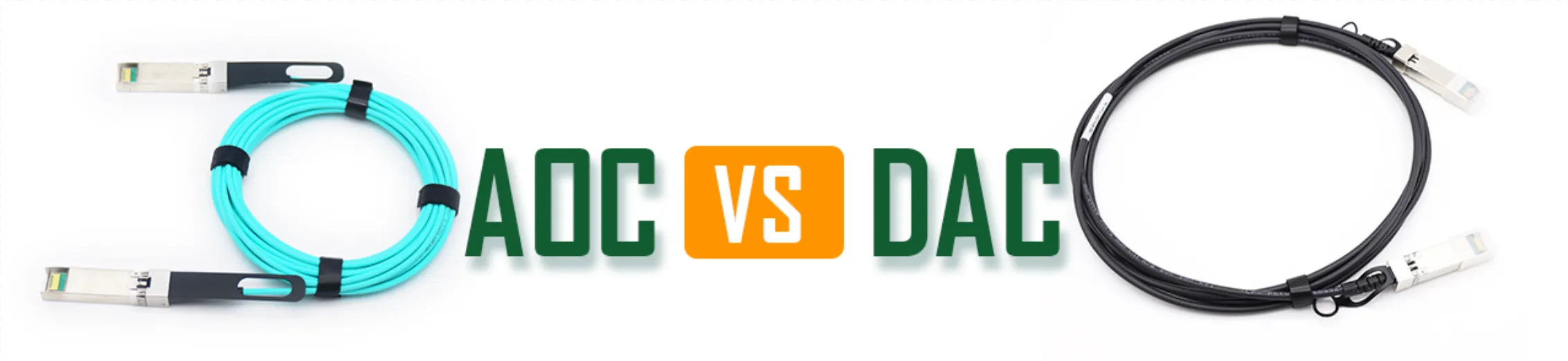
Direct Attach Cable (DAC)
Often called “Twinax,” a DAC is a fixed assembly using copper conductors.
-
Passive vs. Active: Most SFP+ DACs are “passive,” meaning they create a direct electrical connection between switches without signal amplification.
-
Mechanism: It transmits electrical signals directly through shielded copper wires.
Active Optical Cable (AOC)
An AOC looks similar but uses multimode fiber optic strands instead of copper.
-
Always Active: Inside the connectors (transceivers) at both ends, there are active chipsets that convert electrical signals into light pulses and back again.
-
Mechanism: It uses laser technology to transmit data over glass fibers.
2. Technical Comparison: The 4 Key Metrics
Let’s compare these technologies using a standard 10G SFP+ application to illustrate the real-world performance differences.
A. Transmission Distance
Physics dictates the winner here. Signals degrade faster over copper than over fiber.
-
SFP+ DAC: Ideal for very short distances. In a 10G setup, reliable transmission is typically limited to 7 meters (passive).
-
SFP+ AOC: Designed for reach. Using OM3 or OM4 fiber, a 10G AOC can easily transmit up to 100 meters without signal loss.
B. Power Consumption
For massive data centers, every watt counts.
-
SFP+ DAC: Since it has no active components (lasers), a passive DAC consumes negligible power (often < 0.1W). It runs cool, reducing the thermal load on the switch.
-
SFP+ AOC: The conversion from electricity to light requires energy. A standard 10G AOC typically consumes between 0.6W to 1W per end.
C. Weight and Flexibility
-
SFP+ DAC: Copper is heavy and rigid. Thick shielding is required to prevent interference, resulting in a larger bend radius. This can block airflow in crowded racks.
-
SFP+ AOC: Fiber is incredibly thin and light (often half the weight of copper). It has a tighter bend radius, making cable management much easier in high-density environments.
D. EMI Immunity
-
SFP+ DAC: Being copper, it is susceptible to Electromagnetic Interference (EMI) and requires high-quality shielding.
-
SFP+ AOC: Fiber is a dielectric medium (non-conductive). It is naturally immune to EMI, making it the safer choice in environments with high electrical noise.
3. Decision Matrix: When to Use Which?
Based on the technical differences above, here is how we advise our OEM clients to deploy these cables:
| Scenario | Recommended Solution | Why? |
| Inside the Rack (ToR) | SFP+ DAC | For connecting servers to a Top-of-Rack switch (usually < 3m). It is the cheapest, lowest latency, and most power-efficient option. |
| Between Racks (EoR) | SFP+ AOC | For connecting switches across rows (e.g., 10m – 30m). DAC cannot reach this far, and AOC is cheaper/easier to handle than using separate transceivers + fiber patch cords. |
| High Interference Areas | SFP+ AOC | If cables run near power lines or industrial machinery, AOC prevents signal corruption. |
4. The Role of Compatibility (OEM Coding)
Whether you choose DAC or AOC, physical connection is only half the battle. The other half is firmware.
Switches from major brands (like Cisco, Arista, or Juniper) read the EEPROM chip inside the cable connector to verify the vendor. If the code doesn’t match, the port may disable the connection.
The OEM Advantage: High-quality third-party cables are not “dumb” pipes. They are precision-coded. Ensuring your SFP+ DAC or AOC is loaded with the correct compatibility code is essential to prevent “Unsupported Transceiver” errors and ensure seamless network operation.
Schlussfolgerung
In the battle of SFP+ DAC vs AOC, there is no single winner—only the right tool for the distance.
-
Go with DAC to save money and power for short connections (under 7m).
-
Go with AOC for longer reaches, easier cable management, and EMI immunity.
Need a specific configuration? We offer a full range of high-performance DAC and AOC solutions, custom-coded for your specific hardware environment. Contact us for samples and compatibility lists.
FAQ: SFP+ DAC and AOC Common Questions
Is SFP+ DAC cheaper than AOC?
Yes, typically. A 10G SFP+ DAC uses simple copper wire and has no expensive optical components (lasers), making it significantly cheaper—often 3 to 5 times less expensive—than an equivalent SFP+ AOC.
Can I use a 10G DAC cable for a 20-meter run?
No. Passive copper DAC cables are restricted by physics. For 10G speeds, the maximum reliable length is usually 7 meters. For a 20-meter distance, you must use an SFP+ AOC (Active Optical Cable) or a pair of transceivers with a fiber patch cord.
Which has lower latency, DAC or AOC?
DAC (Direct Attach Cable) has strictly lower latency. Because it does not require the time to convert electrical signals to light and back (as AOC does), DAC offers near-zero latency. However, in standard 10G enterprise networks, this difference is usually negligible (~0.1 microseconds).

 German
  English
  Italian
  Spanish