
When planning an indoor fiber optic deployment in the United States or Canada, engineers must look beyond data speed and bandwidth. The most critical factor in indoor cabling is fire safety compliance.
In North America, cabling fire safety is strictly governed by the National Electrical Code (NEC). The NEC classifies cables based on their installation environment and their ability to resist spreading fire. If a procurement manager selects the wrong cable jacket, it can lead to failed building inspections, expensive rewiring, and severe legal liabilities.
In this comprehensive guide, we will break down the North American fiber cable fire ratings, focusing on the critical differences between OFNP vs. OFNR, and explain the “Golden Rule” of cable substitution.
1. The North American Approach: Location-Based Fire Safety
Unlike some global standards that focus purely on the chemical makeup of the cable material, the NEC takes an environmental approach. The code dictates that the required fire rating of a cable depends entirely on where the cable is installed within the building.
To enforce this, independent safety science organizations like Underwriters Laboratories (UL) and the National Fire Protection Association (NFPA) have established rigorous burn tests (such as NFPA 262 and UL 1666) to ensure cables meet specific flame spread and smoke generation limits.
2. What is OFNP (Plenum) Fiber Cable?
OFNP stands for Optical Fiber Nonconductive Plenum. This is the highest and most stringent fire rating assigned by the NEC.
The Plenum Environment
A “plenum” space is a designated area within a building used for air circulation in HVAC (Heating, Ventilation, and Air Conditioning) systems. The most common examples are the open spaces above suspended drop ceilings or below raised floors. Because oxygen flows freely in these spaces, a fire starting here can be instantly blown into other rooms, carrying toxic smoke with it.
The OFNP Requirement
To be rated as OFNP, a fiber cable must pass the extreme NFPA 262 test (also known as the Steiner Tunnel Test). The cable jacket must possess exceptional flame resistance and generate almost zero smoke. To achieve this, manufacturers typically construct OFNP jackets using specialized fluoropolymers (like Teflon/PTFE or highly engineered PVC blends).
3. What is OFNR (Riser) Fiber Cable?
OFNR stands for Optical Fiber Nonconductive Riser. This is the second-highest fire rating under the NEC guidelines.
The Riser Environment
A “riser” space refers to vertical pathways or shafts that pass from one floor of a building to another (e.g., elevator shafts, vertical conduit pathways). In the event of a fire, these vertical shafts can act like a chimney, drawing the fire upward to higher floors.
The OFNR Requirement
OFNR cables must pass the UL 1666 test. The primary engineering goal of an OFNR cable is to self-extinguish and prevent flames from traveling vertically between floors. While highly flame-resistant, the smoke emission standards for OFNR are slightly less strict than those for OFNP cables.
4. The Golden Rule of Cable Substitution
To simplify installation and inventory management, the NEC establishes a strict hierarchy for cable substitution based on safety levels.
The “Golden Rule” of NEC fire ratings is: A higher-rated cable can always be used in a lower-rated space, but a lower-rated cable can NEVER be used in a higher-rated space.
| NEC Fire Rating | Safety Level | Can Be Used In… | Can Replace… |
| OFNP (Plenum) | Highest | Plenum spaces, Riser spaces, General spaces | OFNR, OFNG, OFN |
| OFNR (Riser) | High | Riser spaces, General spaces | OFNG, OFN |
| OFNG / OFN | General | General single-floor commercial spaces | None |
Warning: Installing an OFNR cable in a plenum space is a direct code violation and poses a massive safety risk.
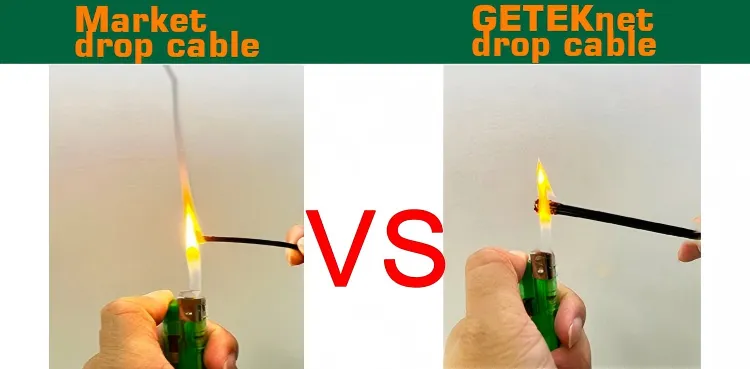
5. Why OEM UL/NEC Compliance is Non-Negotiable
For global buyers and infrastructure contractors, sourcing cables that genuinely meet North American standards is critical. A label is not enough; the product must be backed by verifiable manufacturing processes.
As a premier OEM manufacturer, we understand that fire safety is non-negotiable. We ensure that every batch of raw jacket material is heavily scrutinized and strictly compliant with North American regulations. Whether you need high-density OFNP trunk cables for a hyperscale data center drop ceiling or rugged OFNR distribution cables for a multi-story enterprise building, our facility guarantees verifiable test reports, true UL-listed materials, and absolute peace of mind.
Do not risk your project timeline on unverified materials. Partner with an OEM that engineers safety into every fiber. Contact our technical team today to source fully compliant NEC-rated fiber optics.
Frequently Asked Questions
Q: Can I use an OFNR riser cable in a plenum space?
A: No. OFNR (Riser) cables do not meet the stringent flame-spread and low-smoke generation requirements for plenum air-handling spaces. Installing an OFNR cable in a plenum space violates NEC building codes and will result in a failed safety inspection.
Q: Can I use an OFNP plenum cable in a vertical riser shaft?
A: Yes. Because OFNP (Plenum) holds the highest fire safety rating under the NEC, it exceeds the requirements for riser spaces. It is fully compliant to substitute an OFNP cable in place of an OFNR cable.
Q: What does "Nonconductive" mean in OFNP and OFNR?
A: The “N” stands for Nonconductive. It means the fiber optic cable contains no metallic components (such as steel armor or metallic strength members). Because it cannot conduct electricity, it is safe to install alongside high-voltage electrical cables without the risk of electromagnetic interference or electrical shock.