
The Hidden Variable in Network Latency: Understanding the Fluke Patch Cord Test
In high-speed data center environments, the most sophisticated servers and switches are often undermined by the most basic component in the infrastructure: the RJ45 patch cord.
While many cables on the market claim to be “Fluke Tested,” this label is often ambiguous. For OEM buyers and network engineers, understanding the distinction between a Channel Test and a Patch Cord Test is critical. This article analyzes the technical differences, the production realities of CAT6 vs. CAT6A, and why adhering to ANSI/TIA-568C.2 standards prevents packet loss.

What is the “Patch Cord Test”?
To the untrained eye, two Ethernet cables may look identical. However, under the lens of a Fluke DSX-8000, their performance characteristics can vary wildly.
1. Channel Test vs. Component Test
Most standard market cables are verified using a Channel Test. This method tests the entire link (the permanent link plus the patch cords). The standard is looser because it allows the patch cord to “borrow” headroom from the permanent link. A cable can be mediocre and still pass a Channel Test.
2. The Component (Patch Cord) Test
The Patch Cord Component Test, illustrated in recent LinkWare™ PC reports, is significantly more rigorous. It uses specific Test Adaptors to isolate and verify the patch cord itself.
-
Objective: It eliminates the masking effects of the permanent link.
-
Result: It guarantees that the cable meets strict ISO/IEC-11801 and ANSI/TIA-568C.2 standards individually.
Technical Note: This is often referred to as a “Jumper Cable Test.” It verifies long-term usability and high stability, eliminating the “invisible” packet loss that occurs in high-demand environments.
The Production Reality: Understanding Yield Rates
Achieving a “PASS” on a Fluke Component Test is an engineering challenge. Unlike the easier Channel Test, the Component Test is unforgiving regarding near-end crosstalk (NEXT) and return loss. Based on transparent data from Geteknet’s normal production lines, we can see the reality of high-standard manufacturing:
-
CAT.6 Patch Cords: Under normal production conditions, approximately 85% of cables naturally meet the strict criteria of the Fluke Component Test.
-
CAT.6A/7 Patch Cords: Due to higher frequency requirements (500MHz+) and stricter shielding demands, the natural pass rate on the production line is approximately 70%.
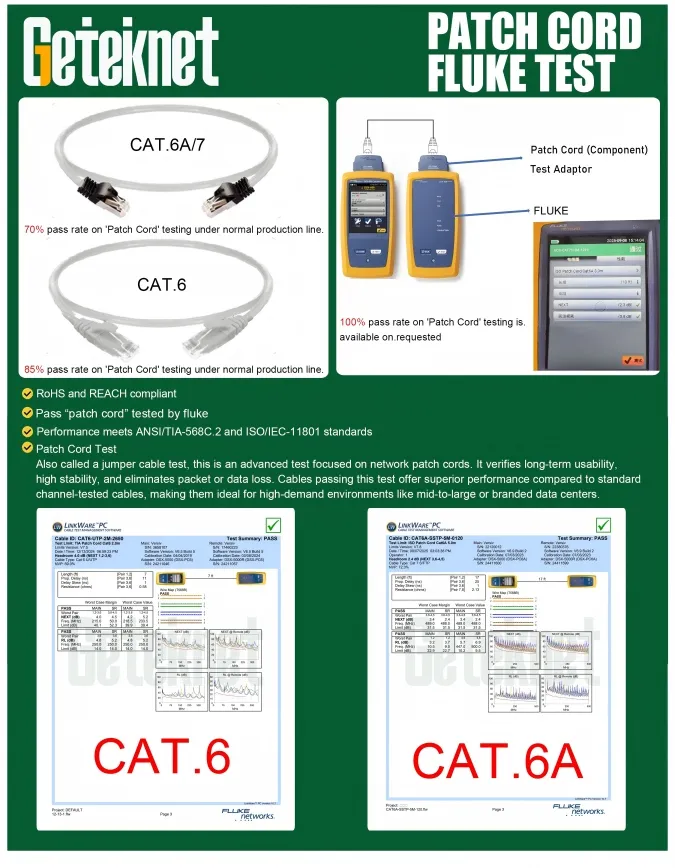
What this means for buyers: This data highlights the difficulty of the test standards. It shows that a “standard” production run—without specific filtering—will naturally contain units that fall just short of the rigorous Component Test limits.
For critical network environments, selection is key. This is why premium OEM services offer a guaranteed 100% pass rate option upon request. By choosing this service, buyers ensure that the manufacturer has individually tested and sorted the production batch, filtering out the non-compliant units (the 15-30%) and delivering only the cables that have explicitly passed the Fluke Component Test.
Decoding the LinkWare™ Test Report
When reviewing a test report for OEM validation, three key metrics determine the quality of the “Patch Cord Component Test”:
Headroom: A higher headroom (measured in dB) indicates better signal integrity. High-quality cords often show headroom of 1.8 dB to 4.0 dB above the limit line.
NEXT (Near-End Crosstalk): This measures interference between pairs. High NEXT margins ensure that signals on one pair do not corrupt signals on another.
Wire Map: Ensures continuity and correct pin configuration (T568B/A), essential for PoE (Power over Ethernet) safety to prevent arcing.
Compliance Beyond Performance
Performance is useless without safety. Professional OEM network patch cords must also meet environmental and safety regulations:
-
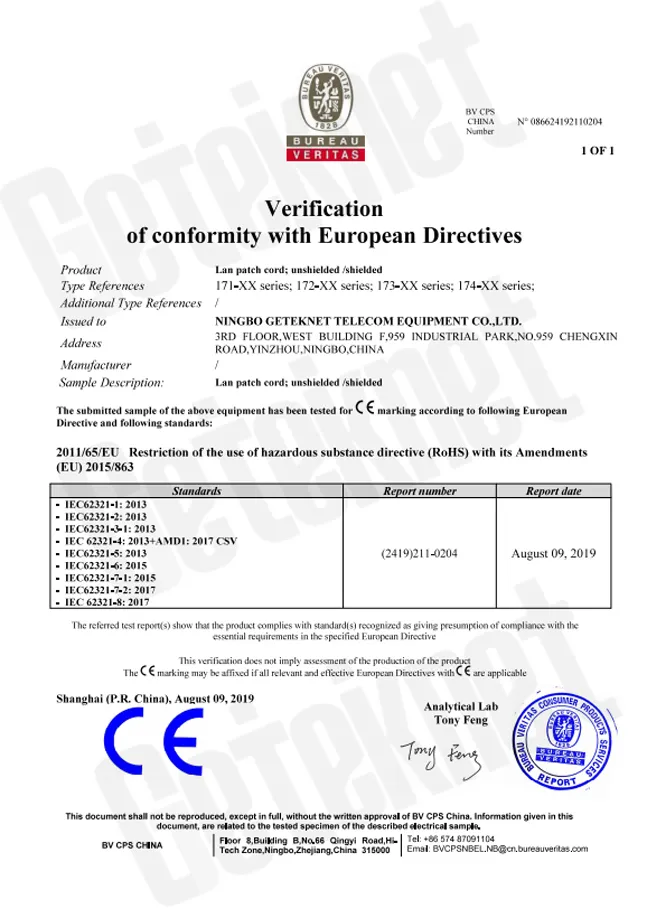
RoHS & REACH Compliant: Ensures the PVC or LSZH jackets are free from hazardous heavy metals and chemicals.
-
PoE Readiness: With the rise of Type 3 and Type 4 PoE, resistance unbalance (tested by Fluke) becomes critical to prevent heat buildup in bundles.
Conclusion
In the hierarchy of network troubleshooting, the physical layer is the first line of defense. Specifying cables that pass the Fluke Patch Cord Component Test is not just about adhering to standards—it is about insurance against downtime.
Whether you are deploying a mid-sized server room or a branded data center, demanding the “Component Test” verifies that your infrastructure is built on solid ground.
At Geteknet, we understand that “good enough” doesn’t work for critical networks. Our OEM solutions offer 100% tested options to ensure your requested specifications are met with verifiable LinkWare™ reports.
If you are looking for an OEM partner that prioritizes quality and safety with Fluke Patch Cord Component Test, we are here to help. Our patch cords also pass UL certification, please refer to Understanding UL Certification: The Safety Gold Standard for Cabling Industry .
Contact the Geteknet Team today to request a copy of our test reports or to discuss your custom patch cord requirements.

 English
  German
  Italian
  Spanish