
As national governments and private internet service providers (ISPs) race to deliver gigabit broadband, the telecommunications industry is confronting a severe bottleneck: a global shortage of skilled fiber technicians. In markets across North America, Europe, and Latin America, the labor costs associated with Outside Plant (OSP) installations are skyrocketing. To mitigate these escalating expenses, network architects are shifting their strategies toward pre-connectorized FTTH solutions.
By transitioning away from traditional field fusion splicing to a plug-and-play Optical Distribution Network (ODN), operators can drastically reduce both CAPEX and OPEX. In this engineering guide, we analyze the hidden costs of legacy splicing methods and explore why partnering with an OEM for pre-terminated optical infrastructure is the future of telecom deployments.
1. The Hidden OPEX of Traditional Fusion Splicing
Historically, constructing an FTTH drop network required technicians to physically splice individual bare glass fibers in the field. While fusion splicing creates a highly reliable connection, the operational realities are fraught with financial inefficiencies.
-
Skilled Labor Dependency: Fusion splicing cannot be performed by entry-level labor. It requires highly trained, highly compensated technicians capable of operating delicate machinery and reading optical trace parameters.
-
Expensive Equipment Capital: Each field crew must be outfitted with precision fusion splicers, optical cleavers, and OTDR testing equipment. A single fully equipped splicing truck represents a massive capital expenditure.
-
Environmental Vulnerability: Splicing bare fiber requires a clean, controlled environment. In harsh outdoor conditions, technicians must erect splicing tents, drastically slowing down the “homes passed” metric per day.
2. The Mechanics of Pre-connectorized FTTH Solutions
To bypass these field bottlenecks, pre-connectorized FTTH solutions shift the most delicate and time-consuming work—the fiber termination—from the muddy construction site into a controlled, sterile OEM factory environment.
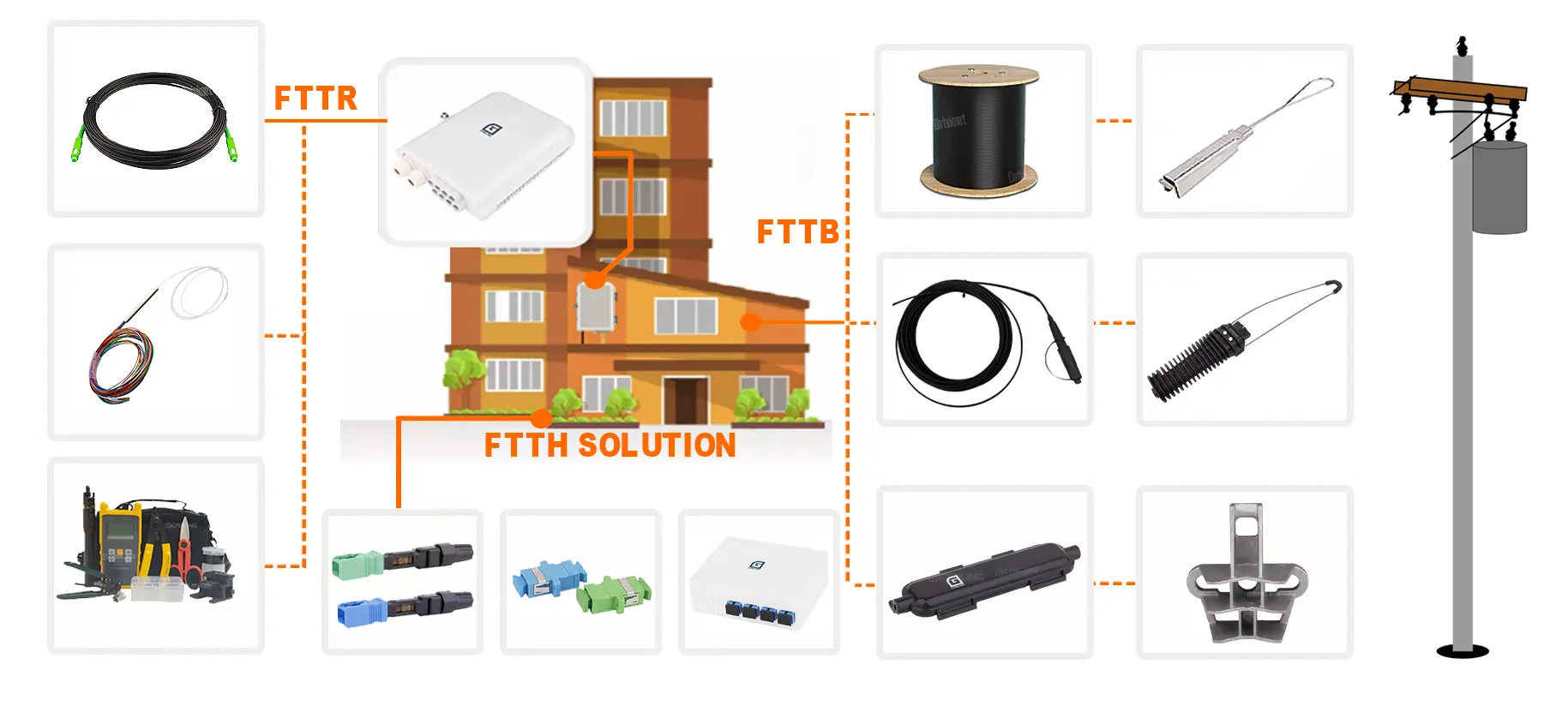
A modern plug-and-play ODN utilizes hardened, factory-terminated fiber drop cables and specialized pre-connectorized Fiber Distribution Boxes (FDBs).
-
IP68 Hardened Interfaces: Instead of opening a splice closure to fuse a new subscriber, the drop cable is terminated with an environmentally sealed, ruggedized connector (such as an OptiTap® compatible or hardened SC/APC interface).
-
Plug-and-Play Deployment: When a new subscriber is activated, an entry-level lineman simply runs the pre-terminated drop cable and plugs it directly into the external port of the distribution box. A tactile “click” confirms the connection, and the waterproof seal engages immediately.
3. Quantifying the Deployment ROI
The adoption of pre-connectorized infrastructure yields immediate, quantifiable returns on investment. By eliminating the need for field splicing, the time required to connect a single subscriber drops from hours to mere minutes.
Because the hardened connectors simply plug into the external ports of the closure, the internal fiber core is never exposed to dirt or moisture, drastically reducing future maintenance dispatches (truck rolls). Consequently, ISPs can utilize standard utility crews for the final drop installation, reserving their expensive, highly skilled splicing technicians strictly for backbone network construction.
4. The Importance of Stringent OEM Quality Control
The success of a pre-connectorized network relies entirely on the manufacturing precision of the supplier. Because the optical connections are not being fused in the field, the physical contact between the pre-polished ceramic ferrules must be flawless to guarantee minimal insertion loss.
When sourcing pre-connectorized FTTH solutions, partnering with a tier-1 OEM manufacturer is critical. Reputable factories employ rigorous quality assurance protocols:
-
Cleanroom Termination: All fiber polishing is conducted in temperature-controlled, dust-free environments.
-
100% 3D Interferometer Testing: Every single connector is scanned to ensure exact ferrule geometry, guaranteeing flawless physical contact and maximum optical performance.
Conclusion
The telecommunications landscape is evolving rapidly, and inefficient deployment methodologies are no longer financially sustainable. By adopting pre-connectorized FTTH solutions, network operators can circumvent the skilled labor shortage, accelerate their gigabit deployments, and significantly improve their network reliability. For enterprise procurement teams and system integrators, securing a direct supply chain with an advanced OEM manufacturer is the strategic key to unlocking maximum FTTH profitability.
Looking for a reliable FTTH products manufacturer, contact us👇
Frequently Asked Questions
Q: What is the main difference between fusion splicing and pre-connectorized FTTH solutions?
A: Fusion splicing permanently melts two bare optical fibers together in the field using a highly specialized machine, requiring skilled labor and considerable time. Pre-connectorized FTTH solutions feature factory-installed, hardened connectors that allow field technicians to simply “plug in” the cable to a distribution box, accelerating deployment.
Q: Are pre-connectorized FTTH solutions waterproof?
A: Yes, premium pre-connectorized ODN solutions are engineered for extreme Outside Plant (OSP) environments. The hardened connectors and external ports on the fiber distribution boxes typically carry an IP68 rating, meaning they are completely dust-tight and can withstand continuous underwater submersion.
Q: Does using pre-connectorized cables increase Insertion Loss?
A: While a fusion splice mathematically offers slightly lower loss than a physical connector pair, modern FTTH networks are architected with optical power budgets that easily accommodate this. Furthermore, because pre-connectorized cables are polished and tested using 3D interferometers in a cleanroom OEM factory, their insertion loss is highly consistent and predictable, unlike field splices which are prone to environmental contamination.